
the
history of the weathervane
French (la girouette, le coq)
Spanish (la veleta)
Dutch (windwijzer)
German (Wetterfahne).
|
|
|
A Shift to New Religions: The Cockerel and Dragon
Although, the earliest recorded British weathercock was erected on the tower of Winchester Cathedral in the 10th century, a similarly dated vane is suggested on Westminster Abbey, in the Bayuex Tapestry [Scene 26]. An unusual first depiction of a weathervane in art. Nonetheless, the oldest physical example of what we consider a traditional weathercock is on display in the Basilica of San Isodora in Leon, Spain. The "gallo de la torre romanica" has been radio-carbon tested to date from roughly 680 A.D. and is believed to be of Pre-Islamic Persian origin. Despite it's astonishing age, this gilded bronze "gallo", was not originally a weathervane. Imported via the Iberian peninsula, it was repurposed as a vane for the basilica's Romanesque tower, in the 11th century. Why the cockerel? A papal edict in the 9th century (Pope Nicholas I) is credited as the catalyst for the cockerel's proliferation in Europe. Without a documented bull, however, historians are on the fence. An 820 A.D. weathercock in Brescia, Italy predates the apparent edict, and if dated correctly, an 8th century Anglo-Saxon riddle dedicated to the "puff-breasted" wind-beaten cockerel on a church's spire, suggests the theme was not just already established but possibly in widespread use. Church
lore surrounding
the theme, is also older, stemming from the 6th century and Pope
Gregory the Great. No matter the timeline, within the span of
three centuries, as Christianity "marched" northward
into Europe, the cockerel became the recognisable skyline calling-card
of the Church's sovereignty and watchfulness over "all the
world". Here, as a golden beacon, the cockerel was not just
a symbol of an alignment with Rome, but was an intended reminder
of piety and of Peter's betrayal of Christ.
What
started as a mandate for a cockerel was quickly wedded with the
weathervane. By the 13th century the word for weathercock ("gallum") and weathervane ("ventrologium") had become interchangeable. Function, form and sybolism had married. One notable aspect of these early gallums is their absence of cardinal letters (NESW), perhaps due to the fact the the church building itself (laying East to West) acted as a powerful physical orientator. The oldest weathercock still functioning in England resides in Devon, flying atop the church in Ottery St. Mary, and reputedly dates from 1340. Interestingly it was designed to "scream"...the two holes in the body enabling this eventually (and probably wisely) closed. By the 14th-15th centuries, the weathercock monopoly seems to loosen, perhaps naturally, as the earliest gallums were already quite individualistic. Style, execution, and detail was dependant on the wealth of the parish (and it's benefactors) and on the blacksmith's skill in creating them. The highly stylized form of the weathercock was decidedly not uniform and in some cases hardly recognisable. A handful of rarer themes enter the scene: the fish particularly, but also "Satan's" beasts (the wyverns, cockatrice and dragon). These more unsual vanes still "spoke" to Christian piety; (for the latter three) they also acted as a warning against sin. For the makers themselves, new themes gave room for greater artistic license, experimentation, and personal expression or "realism". The most notable example of a dragon from the time, is Belgium's golden "Buccoleon" of Ghent. This 11.65 foot-long depiction was forged in copper in 1377. It is beautifully studded with rivets, laying bare it's construction and some of the material issues all vanes of the time were beginning to suffer. The iron on which these copper vanes relied (both as a pivot point, as infrastructure, and for mounting) was reacting and degrading. Many have had to, after centuries of dedicated repair, be eventually replicated & retired. The impacts of the Reformation The 16th-17th century saw a distinct change in three-dimensional weathervane themes as the 1530 Protestant Reformation swept across Northern Europe. The weathercock was losing it's dominion. Celebrating a city's or country's identity rather than just the Church's became a new "statement" and agenda. The Catholics to the South and the Protestants in the North, began a theological and aesthetic battle on the skyline. Eastern Eurpean Orthodoxy weighed in as well. "Le pélican de la cathédrale de Bourges" (copper Pelican c. 1542) in France is noteable. The 1568 Seville "Giralda" is a pinnacle example of Spanish Counter-Reformation iconography (and a bold show of the High Church's return to a Roman-esque figurative aesthetic). St. Petersburg's first iteration of Archangel Gabriel holding a cross, dating somewhat later (1720s), also acts as a powerful reminder to Europe of this newly founded imperial city and it's influence. It is at this moment that the weathercock, disappears entirely from Catholic buildings in Northern Europe.
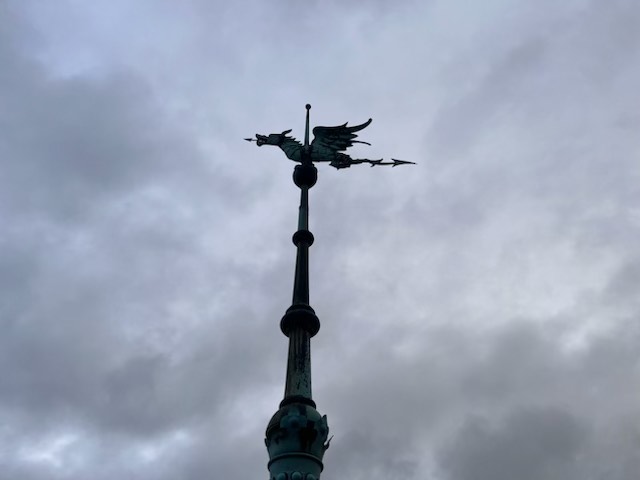
In rebuttal of Catholic symbols, copper weathervanes in Protestant Europe developed a new iconography: the dawn of the gilded "wetterengels" (angels) in Germany, and the "Lutherschwanen" (Lutheran swans) in Belgium. New "guardians of the city" vanes appeared as well, linking locations to patron Saints. Large gilded balls became a commonplace base for these cardinal-less designs. In London, the 1680 dragon of St. Mary-le-Bow spire is erected (a nod to St. George), famously designed by architect Sir Christopher Wren. The Great Fire of London offering a chance to rethink the church skyline of the city, it's identity and the vanes upon it. Port cities began refocussing on their maritime roots. The gilded ship came to fashion. Eventually
three-dimensional Church of England vanes clearly emerged that
embraced not just urban identity, but the individualist identity
of the parish. Cardinal letters start to be added under even the
oldest weathercocks, to celebrate a coronation or royal event.
Some regionally specific themes or nods to benefactor's buried
in the churchyards like the "falcon and fetterlock"
are interesting shows how money streams can effect imagery. The
widening net of the now Church of England spire, by the 18th-19th
century included: gilded carrachs, lambs with flags, dolphins,
a boar's head, and an eagle (in one case in Haslope, a hound with
an arrow through his paw). This expansion of themes shows a desire
to still "shine out" as before (nearly all are gilded)
but also mark identity on a more representative than symbolic
level.
Changing Themes in England As urban centres swelled and new landmark buildings emerged, there was a distinct focus on new "institutions" and their secular spheres and themes. Town Halls began to adopt copper weathervanes. Traders and merchant wealth expanded this further. Earliest vanes denoting this shift include the Royal Exchange's Grasshopper (1560s) and the Lion on the Black Lion Brewery (16th century), as well as noteable 17th century elaborately-rigged sailing vessels in Glasgow & Norfolk.
Three-dimensional
copper weathervanes began to slowly re-align to acedamia, charitable
organizations and even to retaillers: cardinal letters become
the norm, ornate scroll-work and arrows become part of layout
and design, date piercing comes into vogue, initials and names
form part of designs, and ultimately themes widen to a hiatus
with the Victorians. Copper weathervane formerly exclusive to
great-heights and landmark situations finally come into a more
personal sphere...to the residential, where detail, precision
and personality became the focus.
for further information on American weathervane history, the following book is invaluable:
Charles
Klamkin
To
find out more about |
|
Banners
& Etimology: The original of the word "vane" Whilst ceremonial use of military flags, banners, and pennants in cloth, are recorded as far back as the Egyptians(1300 BC), on Viking warships a "new" flat metal quadrant was emerging in the 9th century. Pivoting on a central pole, these fully gilded "fahne" were intricately scribed or pierced in non-ferrous metal. Three examples, recovered from secondary placement on Scandanavian churches are now considered the original "banner" weathervanes of the past. With knotwork or zoomorphic themes, but often a small three-dimensional Ringerike-style beast at their topmost corner, these "fahne" (German equivalent for pennon or flag) combine to create the "wetterfahne", or as we say in English, the "weathervane".
The surviving examples (Norway's Heggen, Sweden's Söderala, and Gotland's Källunge vanes) all indicate through repeated holes along their edge that ribbons (or other decorative ornamentation) might have dangled from the quadrant's frame. It is not hard to imagine the raider's rigid glinting banner, festooned and fast-approaching, as a fearsome sight to those on shore. The gilded "fahne" a reminder of the Viking's might, conquest and warlike intent. Pennons (french=feather, often wavy or split-ended), penants (derivative of pennon), banners (cloth mounted to a pole), and finials (latin= end). By the Middle Ages the metal banner vane became increasingly popular with nobility in England. Until the 17th century these were designed without a "pointer" (making them distinct from the arrowesque vanes of today). All were meant to indicate presence on the battlefield and a point of pride for the bearer. Some argue these ruddy designs served the archer (able to read the wind and adjust aim), other's that the vanes' pole or stave-mount (without finial cap) made for quick installation, replacement or abduction. Whichever, "the noble house's" sheild or insignia, scribed or pierced into the metals surface, underscores a landscape of shifting-ownership, battlefield accomplishment, and a "capture the flag" mentality related to noble seats, the buildings and surrounding land.
What about Heraldry? While heraldry seems a naturally rich source for three-dimensional expression, the banner's prevalence proves the converse was the case. In the 13th century, the need for a royal license stopped heraldic show-boating; the only weathervane style permitted or available (contingent on noble rank & royal favour) were always flat and meant to tell two distinct things: rank and identity.
Square
Banner (or tall oblong): highest
military commander
Royal houses, themselves, also sat within this hierarchical aesthetic. Royal banners or pennons, indeed more striking, were also flat. Here, richly painted detail, fleur-de-lys ornamentation, and more permanence, through the addition of a gilded three-dimensional crown on the finial point, distinguished royalty from lesser nobles. Exquisite royal banners, often mounted in repetition on several peaks can be seen across Europe. The golden crown, of course, an ancient reference to divine-right bestowed upon the bearer, and so, like the gilded weathercock, asserts sovreignity and pre-eminance through peak placement and three-dimensional form.
Note: One unusal manorial practice to circumvent restriction and improve visual impact, was the Tudor stone beast holding aloft a gilded banner. Here, in the 15th and 16th century, the banner was mounted to "hinge" upon the carved beasts' stave. The Manor House at Stanton Harcourt, Oxfordshire was recorded to have had twelve such beasts and weathervanes.
|

|
The rise of the arrow and the cardinal letter
Arrows (as a ground under a theme) or the addition of a pointer (to counter-balance the pennon) were uncommon in England until the 17th century. The earliest arrowesque pointer found on weathervane in England dates from 1577.
What Changed? The industrial revolution changed everything. In England banners and pennons increasingly moved away from copper towards construction in steel. Casting methods saw a boom in black painted silhouette-style weathervanes, with the most popular themes cast and mass-produced to meet the burgeoning middle-class appetite for ornamentation. Victorian architecture opened up obvious peaks and pitches that met the criteria for decorative expression, yet mass-manufactured terracota finials became the preference, often to create a visual cohesion (or sameness) to mews or terraced homes in urban centres.
for further information on Englisn weathervane history, check out these books: A.
Needham
|
Weathervane Trivia
|
AMERICA'S MOST FAMOUS... America's most famous weathervane, reputedly once held for ransom, is the grasshopper perched on top of Fanueil Hall in Boston. Although stylistically very different, this grasshopper is likely based on the 16th century three-dimensional grasshopper weathervane on the Royal Exchange in the City of London. The London grasshopper is 11 ft. long, and survived the Great Fire of 1666, and a subsequent fire in 1838, both of which completely destroyed the building. Sir Thomas Gresham, who founded and built the Exchange in 1564-1570 , is linked by legend to the grasshopper. However, the grasshopper is also the traditional symbol for the merchant and an ancient symbol of good luck.
ENGLAND'S MOST FAMOUS...England's most unmistakably famous weathervane is the "Father Time" weathervane above the scoreboards at Lords. This vane was presented to the Marlyebone Cricket Club by architect Sir Herbert Baker in 1925. This, like the Hermes vane at Twickenham, is a silhouette design. SPOOKY...England's eerie Black Dog Weathervane (Black Shuck) on the Bungay Market in Suffolk is another famous vane, related to death and superstition, and derived from the Norse war-dog, the Hound of Odin. This wild-eyed, teeth bearing, dog in silhouette, rides a lightning bolt and was designed in 1933 by one of the village children, in a competition.
CONTROVERSIAL...An 18 ft. tall copper weathervane of a nude Roman goddess was erected onto New York City's orignal Madison Square Garden in 1891. Designed by American sculptor Augustus Saint-Gaudens, this depiction of Diana the Huntress became the highest point in Manhattan, her head rising some 347 feet above the street and caused much controversy for its nudity and realism. A year later the weathervane was replaced by a smaller version (13 ft. tall) which now resides at the Philadelphia Museum of Art. Subsequently, the larger version ended up on the Agricultural Hall of the World's Columbian Exhibition in Chicago. The bottom half was lost to fire, but bizarrely no one knows what happened to the top!
WORLD'S LARGEST...Two
seperate weathervanes claim to be the World's largest. The first
is a schooner (the overall structure standing 48ft tall, 14
ft long and weighing 4,300 lbs.) in Montague's, MI USA. The
second,in the Yukon Territory, Canada, is an actual Douglas
DC-3 airplane erected at the Whitehorse Airport. |
|
Collecting Weathervanes An American
Folk Art In England the record at Christie's for a gilt Galleon was £14,000 |
|
Since the Industrial Revolution, steel silhouette weathervanes have dominated the English skyline, and no real tendency to label the weathervane as an artform or a cultural icon exists. In America, however, a feircely competitive environment has existed between weathervane manufacturers for nearly 200 years, raising them to the status of a folk art. Many copper designs from big companies like Washburn and Fiske, have been pirated and repeated (e.g. the mermaid and the trotting horse). This has created what is today a large, and somewhat eclectic selection of "traditional" themes, ranging from peaocks to airplanes to quill pens.
|

GREENS Weathervanesbeautifully bespoke copper weathervanes England since 1995


home | about | weathervanes
| sculpture |
new! |
available now | contact
purchasing | installation
| gold leaf | exhibitions
| the artists
| history
| visit